LPD433 decoding
LPD433 decoding refers to the process of interpreting radio signals transmitted in the LPD433 band, a license-free UHF frequency range around 433 MHz used by low-power devices like weather stations, doorbells, and remote controls.
Introduction
LPD433 operates between 433.05 – 434.79 MHz, allowing short-range, unlicensed communications in many regions. Devices send simple data bursts using modulation like On-Off Keying (OOK), often with Pulse Position Modulation (PPM) or Pulse Width Modulation (PWM) to encode bits—short gaps for 0s, long gaps for 1s, or vice versa.
Decoding LPD433
Signals are captured via software-defined radio (SDR) hardware like RTL-SDR dongles, then demodulated to reveal binary data packets. Tools like rtl_433 automatically detect protocols (over 140 supported), parse timings, and output readable info such as temperature or button presses.
rtl_433 is an open-source software for Linux/Windows that tunes to 433.92 MHz, decodes packets, and logs data from nearby devices.
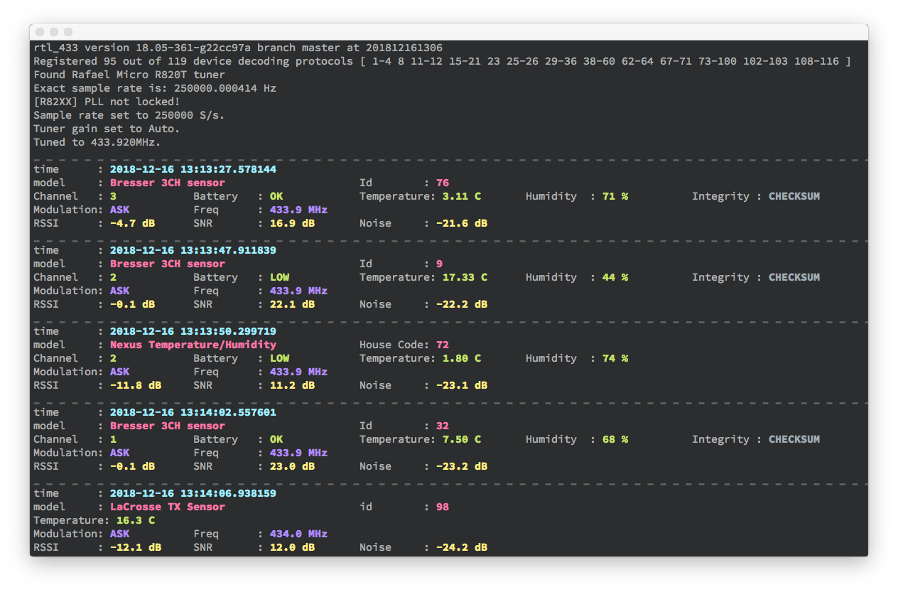
(source: todo-sdr.com)
Quick tutorial
- run
rtl_433software defined radio - watch it identify devices in range, like sensors or door bells